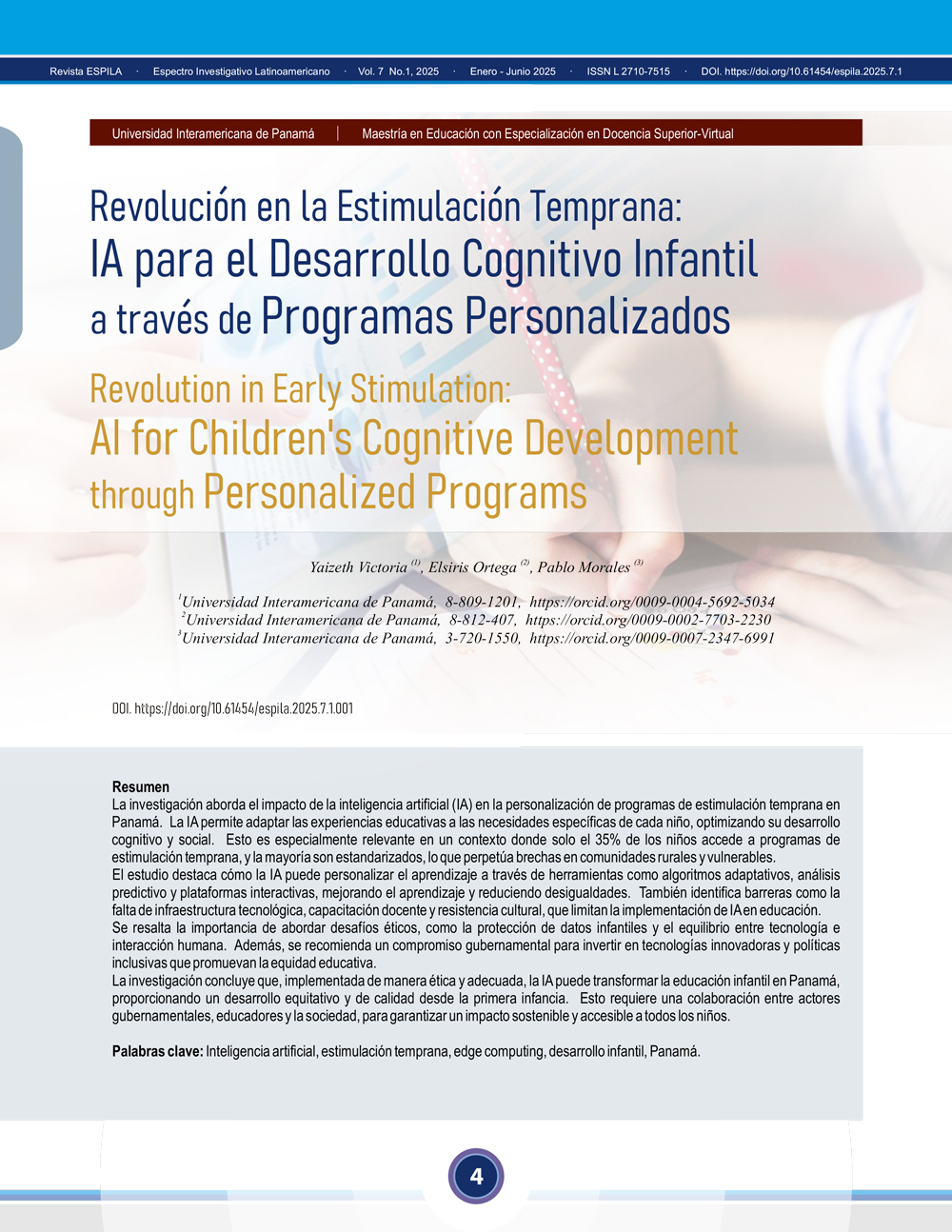
Revolution in Early Stimulation: AI for Children's Cognitive Development through Personalized Programs
DOI:
https://doi.org/10.61454/n9f9dj52Keywords:
Artificial intelligence, early stimulation, edge computing, child development, PanamaAbstract
The research addresses the impact of artificial intelligence (AI) on the personalization of early stimulation programs in Panama. AI enables the adaptation of educational experiences to each child's specific needs, optimizing their cognitive and social development. This is especially relevant in a context where only 35% of children have access to early stimulation programs, most of which are standardized, perpetuating gaps in rural and vulnerable communities.
The study highlights how AI can personalize learning through tools such as adaptive algorithms, predictive analysis, and interactive platforms, enhancing learning and reducing inequalities. It also identifies barriers such as the lack of technological infrastructure, teacher training, and cultural resistance, which limit the implementation of AI in education.
The importance of addressing ethical challenges is emphasized, including the protection of children’s data and balancing technology with human interaction. Additionally, a governmental commitment is recommended to invest in innovative technologies and inclusive policies that promote educational equity.
The research concludes that, when implemented ethically and appropriately, AI can transform early childhood education in Panama, providing equitable and high-quality development from the earliest stages. This requires collaboration between government actors, educators, and society to ensure a sustainable and accessible impact for all children.
Downloads
Downloads
Published
Issue
Section
License
Copyright (c) 2025 Espectro Investigativo Latinoamericano

This work is licensed under a Creative Commons Attribution-NonCommercial-ShareAlike 4.0 International License.